
How Do AI Cameras Improve Safety & Productivity for Sprinkler Trucks?
Ⅰ. Hidden Safety Risks of Sprinkler Trucks in Urban Road Operation
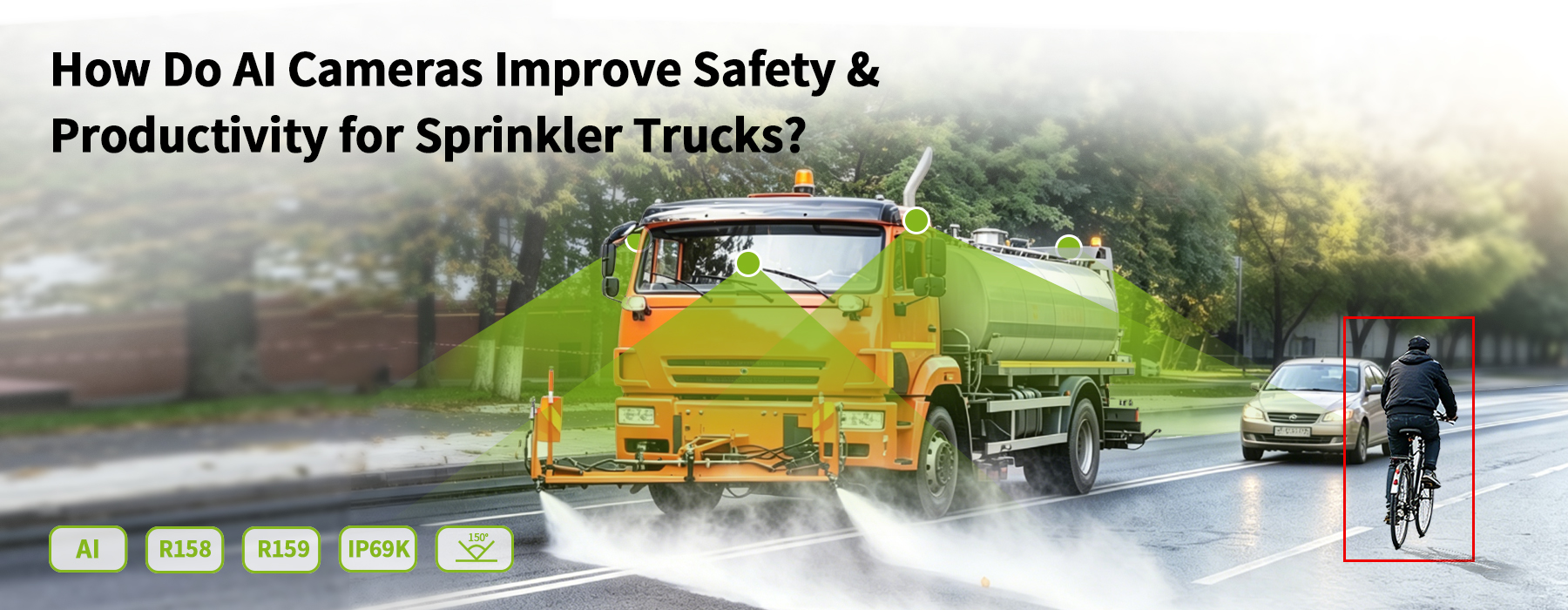
Sprinkler trucks are easily overlooked in urban safety management systems. Travelling at medium and low speeds across urban arterial roads, residential lanes and construction zones, they generate unique hazards rarely covered by conventional fleet safety standards during operation: extensive side blind zones formed during water spraying and high exposure risks for pedestrians along curbs. The deployment of Luview AI cameras fundamentally improves this risky scenario.
Ⅱ. Blind Spots Stem from Inherent Vehicle Structure Rather Than Human Error
Blind zones on sprinkler trucks are structural defects instead of operational mistakes.
Increasing drivers’ frequency of rearview mirror checks cannot offset inherent dead zones caused by vehicle geometry. Typical large sprinkler trucks measure 7–12 meters in length, with water tanks extending toward rear corners and creating wide ground-level blind areas where pedestrians, cyclists and children frequently appear. Traditional rear-view cameras only deliver limited live footage, forcing drivers to respond based on real-time screen observation. Luview AI camera system enables automatic detection and instant alert regardless of whether the driver is monitoring the display; the system triggers warnings autonomously once pedestrians enter dangerous areas.
Ⅲ. On-device Local AI Calculation & Technical Specifications of Intelligent Detection
3.1 Definition of Hardware-based Vehicle AI Detection
The term “AI camera” is loosely used across the industry. For professional vehicle safety hardware represented by Luview JY-814 AI BSD Camera, AI detection carries a definitive technical definition: an embedded inference processor runs trained deep-learning algorithms directly onboard the camera, analyses frame-by-frame video streams and completes all computing locally.
3.2 Core Technical Parameters of JY-814 AI Camera
Equipped with Anchor-Free deep learning algorithm, Luview JY-814 achieves over 96% accuracy for pedestrian and vehicle identification with approximately 50ms system response latency. It features 145° horizontal viewing angle, 80° vertical viewing angle and 165° diagonal viewing angle, alongside a maximum detection range of 28 meters; single-side installation fully covers critical rear-side hazard zones of large sprinkler trucks. The full-HD 1920×1080 resolution camera tracks up to 20 moving targets simultaneously, perfectly matching real-world road conditions with crowds of pedestrians along urban intersections and cleaning routes.
Ⅳ. Three-tier Audible & Visual Warning to Avoid Driver Alert Fatigue
When cyclists or vehicles enter the Green Monitoring Zone, the system triggers a slow intermittent alert tone: Beep————Beep————.
When detected targets move into the middle Yellow Warning Zone, the system outputs a faster, intensified alert tone: Beep——Beep——Beep——.
When targets enter the inner Red Danger Zone, the system activates the most urgent rapid alarm tone: Beep-Beep-Beep-Beep. The audible prompt works inside the cab. When connected with an external warning light bar, it provides pedestrians outside with dual visual and audible warnings. This tiered warning mechanism effectively avoids driver alert fatigue while ensuring immediate and clear reminders for real close-range safety hazards.
Ⅴ. AI-linked Intelligent Water Control: Reduce Complaints, Improve Efficiency and Empower Municipal Operations
Besides safety improvement, operational productivity stands as another core priority. Conventional spraying operation relies entirely on drivers’ subjective judgement to manually adjust or shut off water output upon spotting nearby pedestrians, resulting in two prevalent industry pain points:
First, delayed manual intervention often leads to accidental water splashing on passers-by, triggering continuous municipal complaints and potential legal liabilities in certain regions.
Second, overly cautious drivers cut water supply prematurely at the sight of roadside activities, causing incomplete pavement coverage and redundant repeated routes.
Luview AI camera system resolves both issues via seamless integration with truck water valve control units. Once pedestrians are captured within detection coverage, the system automatically throttles down or pauses water spraying and resumes normal operation after targets leave monitored areas. Drivers can fully focus on vehicle control and traffic conditions with automatic spray regulation handled by the intelligent system.
Measurable operational benefits include fewer public complaints, expanded daily cleaning coverage and reduced cognitive burden for drivers during peak hours. For municipal fleets managing dozens or hundreds of multi-shift sprinkler vehicles, such autonomous operation delivers tangible efficiency gains rather than theoretical benefits.
Ⅵ. Dual IP69K High-protection Product Options for Harsh Sprinkler Working Conditions
Sprinkler trucks operate under extremely tough environments including persistent high-pressure water flushing during spraying, repeated high-pressure washing for maintenance and year-round all-climate deployment requirements.
Luview JY-814 AI camera features IP69K ingress protection – the highest available rating for automotive equipment, certified per ISO 20653 and DIN 40050-9 standards to withstand multi-angle high-temperature high-pressure water jet impact. For sprinkler-mounted cameras that may be directly exposed to water spray during working cycles, IP69K is a mandatory baseline specification instead of an optional premium upgrade.
Operating temperature spans from -20°C to +70°C to accommodate all-season operation across freezing winters and scorching summers. Minimum illumination reaches 0.1Lux under daylight and 0Lux at night via built-in active IR illumination, supporting pre-dawn early-shift operations when regular visible-light cameras fail completely under darkness.
For applications requiring high-definition wide-angle rear monitoring only (installed on rear of water tank without AI detection function), Luview JY-810 is available as a cost-effective alternative: IP69K-rated 150° ultra-wide-angle camera with Sony CMOS image sensor, same -20°C~+70°C working temperature range, serving as complementary rear-view accessory paired with AI side-mounted cameras.
Ⅶ. Authoritative Certifications to Comply with Global Municipal Vehicle Regulatory Standards
Regulatory requirements for vehicle vision systems for municipal vehicles keep tightening globally, especially across Europe. UN ECE R158 (Rear Vision System) and R159 (Moving Off Information System) set explicit performance criteria for vehicle detection and early warning equipment. Luview JY-814 AI camera holds full certification against above standards and helps municipal operators complete regulatory compliance documentation for project tendering.
よくあるご質問
Q1: Standard rear-view cameras are pre-installed on water sprinkler trucks. Why upgrade to Luview AI BSD cameras?
A: Conventional rear-view cameras only output live footage, forcing drivers to constantly monitor display screens to avoid blind spot hazards. Sprinkler trucks feature inherent structural blind spots along the side and rear, where pedestrians and children often fall out of sight. Powered by deep-learning algorithms, the JY-814 AI camera autonomously detects pedestrians and vehicles with 3-zoned audible & visual warning alerts. It triggers active warnings without continuous screen watching, fundamentally resolving innate visibility drawbacks caused by vehicle body design.
Q2: Can the Luview JY-814 AI camera link with the sprinkler’s water valve for automatic water control?
A: Yes. The system connects to the factory electronic control unit of the sprinkler truck. Once the AI identifies pedestrians entering the detection zone, the system automatically throttles down or shuts off water discharge; water supply resumes automatically after pedestrians move out of coverage. This prevents customer complaints from accidental water splashing on passers-by and avoids incomplete road cleaning caused by drivers cutting off water prematurely.
Q3: Subject to continuous high-pressure water jetting during daily operation, does the JY-814 deliver reliable waterproof durability?
A: The JY-814 is rated IP69K, the top-tier protection grade for automotive applications, compliant with ISO 20653 and DIN 40050-9 standards. It withstands multi-angle high-temperature high-pressure washdown. Operating temperature ranges from -20℃ to +70℃ to cope with all-weather conditions, perfectly suited for harsh working scenarios including persistent sprinkling and full-vehicle high-pressure cleaning.
Q4: How to select between IP69K-rated JY-814 and JY-810 cameras?
A: ① Select JY-814 for side mounting and AI blind-spot pedestrian BSD warning: 145° horizontal field of view, 28m detection range and tiered audio-visual alerts, optimized for intelligent BSD recognition.
② Choose JY-810 for fixed rear installation as basic HD rear-view monitoring without AI detection: equipped with 150° ultra-wide-angle Sony CMOS lens for supplementary rear vision.
Q5: Does the product comply with EU municipal vehicle regulations for export on European sanitation sprinkler projects?
A: Luview JY-814 holds UN ECE R158 & R159 certification, meeting EU statutory requirements for blind-spot and moving-off warning on European sanitation vehicles. It supports overseas municipal fleets for regulatory filing and project approval.